
In 2025, AI coding assistants have transformed from novelty tools into essential development partners. Once seen as helpers for beginners, these intelligent systems now power the workflow of top-tier engineers, startups, and enterprises alike.
The keyword “AI coding assistants 2025” reflects not just a trend but a paradigm shift—a glimpse into the future where artificial intelligence doesn’t just write code but understands intent, architecture, and optimization in ways that rival human expertise.
This article dives deep into how these AI companions are revolutionizing coding, the best tools leading the charge, and what the future holds for developers and organizations worldwide.
The Rise of AI Coding Assistants From Automation to Intelligence
In the early 2020s, tools like GitHub Copilot, Tabnine, and ChatGPT began the AI-assisted coding revolution. By 2025, the evolution is profound. AI no longer just autocompletes code—it analyzes context, predicts logic, and even suggests architectural improvements.
Key Advancements from 2020 to 2025
Year Key Milestone Impact on Development 2021 Launch of GitHub Copilot Popularized AI pair programming 2023 ChatGPT 4 integrated into IDEs Conversational debugging and refactoring 2024 Rise of specialized AI frameworks Domain-specific coding assistance 2025 Context-aware and self-improving AIs Full project understanding and code optimization
These advancements mark the transition from predictive code generation to cognitive code collaboration, where AI understands not just syntax but the semantics of development.
Why AI Coding Assistants Are Essential in 2025
The software landscape in 2025 is faster, more complex, and globally distributed. Teams must build, test, and deploy at record speeds. AI coding assistants help developers stay ahead by offering:
Enhanced Productivity
AI assistants can generate code snippets, complete functions, and even suggest APIs within seconds. This drastically reduces manual effort, allowing developers to focus on creativity and problem-solving.
Error Reduction
Modern AI models use large datasets of correct and optimized code. They spot potential bugs, logic errors, and vulnerabilities early—often before compilation.
Context-Aware Development
Unlike earlier versions, 2025 AI coding assistants remember previous code, project architecture, and coding style. They can tailor suggestions to each developer’s habits.
Faster Learning Curve for Beginners
New coders benefit immensely from conversational AIs that explain syntax, best practices, and logic in real time—effectively acting as personalized mentors.
Top AI Coding Assistants in 2025
The market is brimming with advanced tools. Here are the best AI coding assistants of 2025, each offering unique capabilities:
GitHub Copilot X (2025 Edition)
Powered by OpenAI’s latest model, Copilot X has become a true co-developer. It supports voice commands, code review automation, and integrates seamlessly with Visual Studio Code and JetBrains IDEs.
Key Features:
- Multi-language support (Python, JavaScript, Go, C++, etc.)
- Context memory across projects
- Real-time error fixing and optimization
Tabnine Pro 2025
Tabnine’s enterprise version offers AI-driven code compliance and team-based learning. It adapts to company-specific coding guidelines.
Ideal For: Enterprise teams prioritizing security and privacy.
Amazon CodeWhisperer 2.0
AWS’s assistant excels in cloud integration. Developers can write Lambda functions or deploy infrastructure as code effortlessly.
Highlights:
- Deep AWS ecosystem integration
- Security vulnerability scanning
- Multi-cloud deployment recommendations
Replit Ghostwriter 2025
Aimed at rapid prototyping, Ghostwriter is perfect for indie developers and students. It now includes a project overview dashboard and AI bug explanation module.
ChatGPT for Developers (GPT-5 Edition)
As of 2025, ChatGPT’s developer mode provides interactive pair programming, code documentation, and test case generation—all within natural conversation.
Key Advantage: Context-rich conversation that understands project intent.
How AI Coding Assistants Improve Team Collaboration
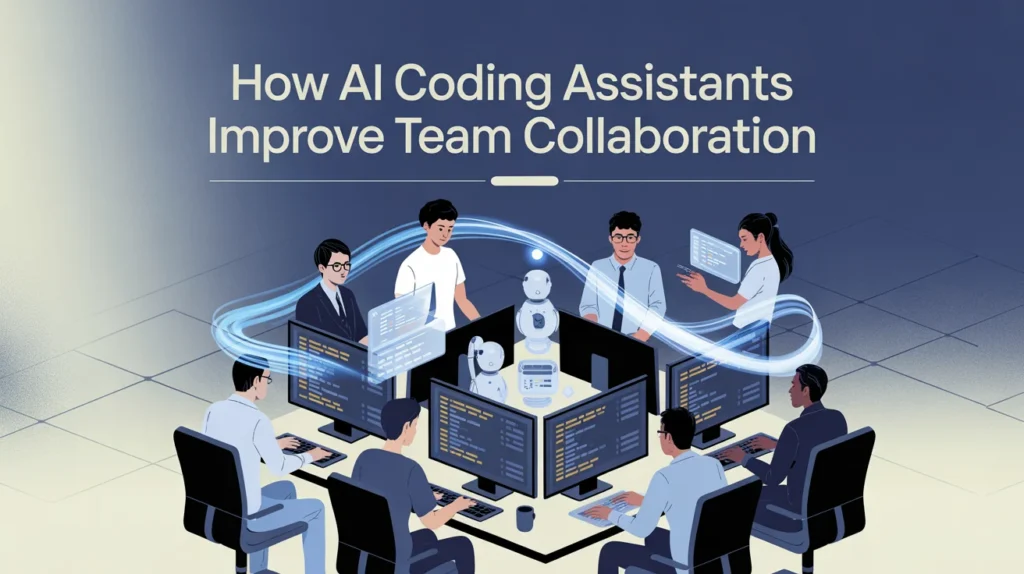
The latest AI assistants act as collaborative hubs, not isolated tools. They synchronize with project management systems like Jira, GitHub Issues, and Slack.
AI in Team Workflow:
- Code Review Automation: AI suggests changes, flags style violations, and scores pull requests for quality.
- Documentation Generation: Natural-language summaries make onboarding easier.
- Task Prediction: The AI predicts upcoming coding needs based on ongoing project activity.
This results in fewer communication gaps, improved version control, and accelerated delivery cycles.
Technical Capabilities of AI Coding Assistants in 2025
AI coding assistants now leverage transformer-based architectures combined with reinforcement learning from developer feedback. This hybrid approach allows them to:
- Understand high-level architecture across files.
- Recommend optimized algorithms.
- Refactor legacy code automatically.
- Maintain consistent naming conventions and documentation.
Core Technologies Powering AI Coding Assistants
Technology Function NLP (Natural Language Processing) Conversational code guidance LLMs (Large Language Models) Context understanding and code generation Reinforcement Learning Continuous improvement based on feedback Knowledge Graphs Semantic linking of code components Cloud APIs Integration with CI/CD pipelines
AI and Security Smarter, Safer Code in 2025
Security remains a top priority in 2025. AI coding assistants not only write functional code but analyze it for security vulnerabilities in real time.
Security Features Include:
- Automated dependency checks
- OWASP vulnerability scanning
- Real-time alerts for unsafe patterns
- Secure API key management recommendations
This has made AI an indispensable ally for DevSecOps teams, ensuring compliance and reducing human error.
Ethical and Practical Challenges of AI Coding Assistants
Despite the progress, AI assistants in 2025 face ongoing challenges:
Intellectual Property (IP) Concerns
AI sometimes learns from open-source repositories, raising questions about ownership of generated code.
Over-Reliance on AI
Developers risk becoming dependent on automation, potentially eroding fundamental problem-solving skills.
Bias in Training Data
AI models trained on biased datasets may produce suboptimal or insecure code recommendations.
Solution: Continuous auditing and transparency in model training.
The Future of AI Coding Assistants 2026 and Beyond
By 2026, expect AI assistants to evolve into autonomous development entities capable of managing entire codebases. Future versions may:
- Write, test, and deploy full applications autonomously.
- Collaborate across teams via voice-based agents.
- Integrate with VR/AR interfaces for immersive coding environments.
AI’s future lies not in replacing developers but enhancing their creative and cognitive capabilities.
Tips for Maximizing AI Coding Assistants in 2025
To get the most from AI tools:
- Provide Clear Prompts: Describe your intent precisely.
- Use Version Control: Always track AI-generated code.
- Review for Logic: Validate suggestions to maintain control.
- Train Custom Models: If possible, fine-tune AI with your own datasets.
- Encourage Feedback Loops: Let the AI learn from your corrections.
Internal Linking Suggestions
- Link to articles on machine learning in software development.
- Link to AI ethics in programming.
- Link to guides on best coding practices for 2025.
FAQs
What are AI coding assistants in 2025 capable of? They can generate, debug, and optimize code while understanding project context, developer style, and architecture.
Which is the best AI coding assistant in 2025? GitHub Copilot X and ChatGPT for Developers (GPT-5 Edition) are considered top-tier for their accuracy and conversational depth.
Are AI coding assistants replacing developers? No, they enhance productivity and creativity but still require human oversight for innovation and decision-making.
How do AI assistants ensure code security? They scan for vulnerabilities, recommend safe patterns, and integrate with DevSecOps workflows for continuous compliance.
Can beginners use AI coding assistants effectively? Absolutely. AI tools explain concepts and provide real-time suggestions, making them perfect learning companions.
Conclusion
As we navigate 2025, AI coding assistants stand as the most transformative force in software development. They merge intelligence with intuition, reshaping how humans and machines collaborate to create technology. Developers who embrace these tools early will gain a decisive advantage in speed, accuracy, and innovation. The future of coding isn’t human or AI—it’s the synergy between both, crafting the digital world of tomorrow.